Friday, January 22, 2021

Conferences in the After-Times

What will conferences be like when COVID is in the rear-view mirror*?

Just over a year ago, the three co-editors of this blog, Kiyoko Gotanda, Andrew Hendry, and Dan Bolnick, were chatting around a bonfire at the American Society of Naturalists' conference in Asilomar CA. Afterward, we added on a brief outing to see elephant seals, and then reconvened at the Hendry Winery in Napa for a wine tour, wine tasting, and brainstorming a grant proposal. It was scientifically productive, and an utter blast culminating in Rowan Barrett and I pretending to be elephant seals engaging in a contest.


A year later, this kind of social / scientific gathering seems far off. Conferences have been cancelled, like the Evolution 2020 meeting, or delayed a year or more (like the Gordon Research Conference on Speciation that Katie Peichel and Dan Bolnick were organizing for Feb 2021, now put off till 2023). Other conferences have emerged to fill the void, giving graduate students and postdocs a platform to disseminate their work and connect with peers via Zoom or other platforms. The American Society of Naturalists (which normally meets every other year) held an off-schedule Virtual Asilomar via Zoom in early January 2021, specifically to give PhD students and postdocs a platform to speak (the talks are now posted here). Unlike the usual Asilomar meeting, which is capped at 200 people due to the size of the venue and a desire to maintain a smaller scale where more drawn-out conversations are easier, Virtual Asilomar was open to all viewers. It drew 710 registered participants from around the world: 569 from North America, 66 from Europe, 27 from Asia (mostly India), 40 from South America, 9 from Australia and New Zealand. Some sessions had presenters sitting on 4 different continents - and this under-counts participation because many talks are continuing to accrue views on the ASN Youtube Virtual Asilomar video playlist.  A quick perusal of these videos suggest that many have accumulated 50 - 200 views in the 2 weeks after the conference. This highlights the fact that the virtual meeting broadened participation in ways that we will be loathe to abandon when COVID (hopefully) recedes into a mythical past. All of these contrasts led us (all slightly skeptical of Virtual Conferences before trying them) to ask:

What aspects of virtual conferences worked well?

What aspects didn't?

And, most importantly, what features of COVID-era virtual conferences should be folded into meetings in the After-Times when we are free to travel again? (artists' rendering below)
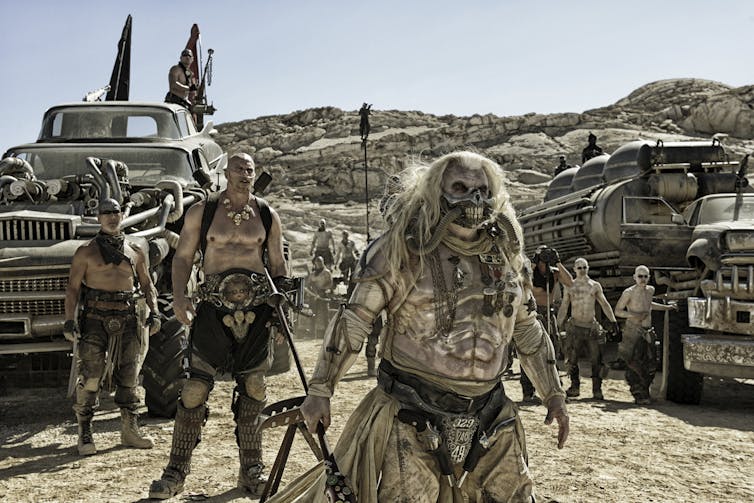
Frenzy on Fury Road: Mad Max faces a post-digital apocalypse


The following is a summary of our own thoughts on this issue, drawing also on responses to a Twitter query of Dan's, where this conversation may continue to unfold. Be aware when reading the thoughts below that there's no one-size-fits-all answer. For some people the weekend meetings were better, for some people they were worse, for example.


1. What aspects of virtual conferences worked well?


* Price Tag. (Most) virtual conferences are much cheaper than the in-person conferences from the Before-Times, although there were exceptions. The Ecological Society of America conference in summer 2020 was expensive enough to deter many people from engaging (hundreds of dollars to view pre-recorded videos). But even when registration is not free, virtual meetings don't require airplane/train tickets, hotel rooms, catered food, and ground transportation - and so will still be far cheaper than in-person meetings. If you have research funds, you save enough to pay your research staff a bit more, or do an extra lane of Illumina sequencing or whatever.

* Inclusivity. Virtual meetings can be attended from far away without travel, enabling participation by people from around the globe, including in places from which travel would be prohibitively expensive. Virtual meetings enable participation by undergraduates or graduate students who lack travel funds, and faculty at smaller institutions who lack conference support grants.

* Convenience. You can participate from the comfort of your own home in your pajamas. Dan left his laptop on to watch videos while baking, and the next day enjoyed the fruit of those labors with muffins and coffee while watching talks. You can knit, craft (Dan rewove the seats on a couple of ladderback chairs while watching talks), enter data (Andrew extracted data from his camera trap videos), clean up your references (Kiyoko cleaned up citations in her reference manager as she downloaded the cool papers mentioned in talks), and otherwise multitask while paying attention to the scientific content.


* Carbon savings from reduced travel. Admittedly, spinning the drives at Google or Zoom does generate substantial carbon - but much less than in the case of travel, or - at least - airline travel.

* New modes of speaker feedback and discussion. Many people commented that Slack channels, chat rooms, twitter, and other online tools gave opportunities for viewers to give speakers live feedback and questions during and after the talk in drawn-out conversations that were often more effective than might happen when you must rush off to the next talk. One good suggestion is that chat room tools should forward questions to speaker's emails so they don't have to keep checking for days afterwards to see if there are any questions arriving later. Caveat: although it could be distracting to viewers watching a talk to see ongoing conversations about previous talks. Commonly used online tools mentioned included: Zoom, Teams, Gathertown, Twitter, Slack, and Remo

* Concurrent sessions All conferences have to make a choice to either artificially limit who can speak, or else have so many speakers that there must be concurrent sessions. Viewers must then choose which talks to view, and which to miss. Most virtual conferences record the talks and post them for people to view after the fact, so you can see both of those simultaneously scheduled talks you were excited to learn from! Caveat: Many people said this is a great benefit but many also noted that they didn't actually avail themselves of the opportunities it affords.

* Relaxed format. Some online twitter respondents noted that virtual presentations feel more casual and relaxed, causing less anxiety, which in turn improves self confidence and speaking quality and clarity. And some speakers can further reduce anxiety by pre-recording talks that are then played during the relevant session.

* Pause and rewind. Want to linger on a detail? Need to take a call? Cat walking across your keyboard? Kid vomiting carrots all over the floor? Its okay, you can pause that recorded video, or rewind, and catch up or revisit a point. 

* Come one come all. Most meetings need to book a certain number of rooms and days, which constrains the number of presenters due to building constraints. And the audience size is capped by fire code limits on seats in a room. Neither apply to virtual meetings. As Mark McPeek wrote "The stated goal of ASN and the other societies during discussion last summer was to provide opportunities for early career researchers. Limiting the number of contributed paper slots is antithetical to that goal."

* Shorter day.  At physical meetings, senior folks often duck out for a half day at a time to catch up on emails, editorial decisions, grant writing, and so on; putting out the dozens of proverbial fires that seem to crop up every day. We always feel guilty about this because we traveled so far, and are paying good money, and should be meeting colleagues and students. Some virtual meetings just build this constraint into the schedule via half-day time lines. And its okay, because its not like you are paying for a hotel room. More generally, these meetings can achieve flexible schedules: one day per week for a month, three half days in a row, or 24 consecutive hours to serve all time zones around the globe.

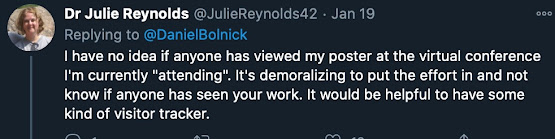
* Posters by any other name.  For some, live poster sessions can be awful: crowded, hard to navigate, hard to hear, hard to read. And that's all the more true for people with disabilities affecting mobility: hearing in over-loud echo chamber rooms, navigating tight spaces with few places to sit, and seeing small font posters. Virtual poster sessions can fix these, but are the target of both strong positive and negative feelings. It seems there are some ways to do this well, and some ways to do this poorly. Many people complained that poster sessions are useless online, and should be replaced by 3-minute lightening talks. There were complaints of small font size, lack of interaction, and inability to see who if anyone is viewing your hard-work posters. Other people clearly had great experiences. The software likely makes a big difference. Some conferences used Slack and each poster had a channel in which attendees could ask questions asynchronously. For more synchronous experiences, "GatherTown is best for poster presentations" - Caitlyn Foster. 


* Networking in small interest groups /breakout rooms /chat windows came up a lot as a positive in people's comments.

* Good moderators matter, both to keep everything exactly on time (especially with concurrent sessions) and for managing Q&A sessions. For many conferences, the arrangement seems to be that people type in questions into a chat window which are then picked and read by the moderators. This encourages some shy people to ask questions, and lets a good moderator ensure more age/gender balanced sources of questions. 


Here's a review of a virtual conference that went well: https://ecologyforthemasses.com/2020/12/22/the-bes2020-festival-of-ecology-write-up/


2. What aspects didn't work - things that future virtual meetings should avoid?

A number of people on twitter commented that they just can't stick with a virtual meeting. For example: "Tried virtual conference twice, it just does not work for me" - Misha Matz.  This is a fairly common sentiment. 


* Lack of in person encounters. The number one sentiment seems to be that virtual conferences have their advantages, but are utterly lacking in the primary value conferences deliver to many of us: impromptu networking, accidental conversations that lead to collaborations, chance meetings, and so on. Then there's the cameraderie. Viewing the Virtual Asilomar meeting made many of us feel deeply sad at all the good friends we missed. The wine tours missed with old friends. The elephant seals not seen. We miss you folks!


* Zoom fatigue. Oh boy! Many of us just spent the last 3 months teaching on zoom and meeting with students and colleagues on zoom. Now you get to have more zoom! You know exactly what we mean. Zoom fatigue can be way worse than lecture hall fatigue.

* Distractions. It is too easy to get up and walk away from your laptop and get distracted at home; whereas, when you travel to a conference, and are in a room with other people, there's a helpful element of peer pressure to keep you focused. 

* Work/life time balance. Without travel away from home, it is harder for many of us to step away from our daily obligations. When we travel to a meeting, we miss our kids, our partner, but they understand we are away. When we watch a zoom meeting from home, we are right there in their midst, available for interruption. For some people, this means weekends are an absolutely impossible time to participate because kids aren't in school or day care. Further, weekends are sacred family time for many people when they are home. For others, by contrast, a partner can watch the kids during the weekend, but must be away at work during the weekday. There's no universally successful option here. Steve Cooke: "When conferencing from home, weekends are a hard NO."


* Participation drop-off.  Based on the Genetics Society of America conference in summer of 2020, which strung out talks over a longer time, we are told that participation trailed off over successive days, so stringing a meeting out over many days may be a disservice to the later presentations.

* Pre-recording loses 'live' feel. Mark McPeek writes:  "The idea of having all talks pre-recorded will undercut the feeling of actually being “at” a meeting, and make you feel like you are sitting on a youtube channel all day.  I think having live talks (and certainly with the option for a person to choose to pre-record) made Virtual Asilomar feel much more like a real meeting and human."

* Lack of social events. Virtual meetings that lack social events aren't really meetings, some feel. Virtual Asilomar had a few social events, most notably the natural history trivia night organized by heroic graduate students, but some comments on twitter expressed a desire for far more events. A few spur-of-the-moment Zoom Beer offshoot meetings were also held - and were great fun (although less so than in person).

* Time zones are rough. As one tweeter noted, when you travel to a destination in another time zone, you have the local sunrise/sunset to get you on track. Sure there's jet lag, but you adjust, especially if you go a day or two early. But when you are at home, an afternoon talk in the US is the middle of the night in India and there's no sunlight to help someone there adjust and stay awake. Andrew: Even people on the opposite coast of North America found the 3 hour time shift awkward - especially in relation to normal evening family activities. Better time zone accommodations are needed. Perhaps rolling 24-hour long meetings so everyone around the world has something at a reasonable time for them (and can view the youtube videos after for the talks in the middle of their night). In February, Kiyoko will be giving a keynote at 4am local time because of time zones. She might break her no-caffeine rule for this....

* No napkins to scribble notes on. Some of us think by drawing on chalk or dry erase boards, which should be present scattered around any conference venue. We need virtual dry erase boards to write on when conversing with far-distant peers in chat groups. These exist on a number of online meeting platforms.

* Technology problems. Many people complained that switching between different sessions can be difficult: you have to sign out of your zoom session, find the url for the other, sign in all over again, for instance. This may be one point where free cheap conferences versus expensive conferences that pay for fancier software may make a difference. 

* Where is everyone? When the audience all have the camera off, there's no feedback, no expressions of enthusiasm or puzzlement, no sense of community. If you can possibly manage, keep your camera on and smile and nod for the presenters. Of course, this makes some of the above "at-home" freedom disappear as you feel you can't just get up and walk away during a talk - perhaps listening still from the kitchen. The verdict is still very much out on this one.

* Lack of closed captioning. This is a tough one because the cost can be really high to do professional closed captioning. The cheap automated versions are junk for technical talks (although they might still be helpful for people struggling with the language), and the cost for professional ones gets passed on to the attendees. There are surely ways to do better.

* Internet accessibility. Virtual meetings are bad for people with poor/unreliable internet (e.g., rural area residents)

Bernie attending a virtual meeting


3. What features of virtual conferences should be folded into meetings in the After-Times when we are free to travel again?


It is abundantly clear that most of us want to resume in-person meetings for the networking and the personal conversations; but that we also want to see the low cost, inclusivity, and accessibility of virtual meetings persist in some form. Many people suggested they might go to one live conference per year, and attend a few virtual ones. (And it might be easier to engage more in a virtual conference when we are no longer on Zoom all day long for months on end.) It remains to be seen whether the future holds a mix of some all-in-person and some all-virtual meetings, or whether we see hybrid meetings that are in-person for people who can attend, and virtual for those who cannot. Such hybrid meetings have the negative implication that not everyone has equal access and equal participation; yet there's just no way to have the virtual participants have 100% the same experience as the in person attendees. But this means that those with funds and proximity can get benefits that the less-well-funded and farther-afield colleagues cannot afford or access. Really, that's always been the case with live meetings. But the virtual experience lately brings that fact into sharper focus for those of us privileged enough to be in the conference-attending crowd. Hybrid conferences seem likely to be the best available option that retains the possibility of in person experiences while doing our utmost to bring others into the experience as best we can. Conferences will not be the same in the After-Times: and the opportunity is there to make them better.


A few overarching rules seem to stand out for future in-person meetings:

* Record talks for non-attendees to view, and for people with concurrent session conflicts. Doing so improves access for people from far away, and for under-funded researchers that can't afford in-person meetings.

* Consider having talks pre-recorded, but the speaker active at answering questions live during the talk.


* Permit pre-recorded or live virtual presentations in in-person meetings, to enable people from the other side of the world to present. Live is generally better, it seems; but pre-recorded needs to be an option for someone 12 hours of time zone away. Sure, it isn't the same but it is still better than nothing.

* Create chat rooms with in-person and remote participants for scientific conversation, debate, Q&A sessions.

* Create social events that merge virtual and in person attendees

* Have discussion panels with both in person and remote discussants.

* Get a cadre of senior faculty / established scientists to circulate among chat rooms and find talks that don't have comments/questions, and post something to start an engagement with the neglected material to help build network and community.


* Conferences typically provide help with child care (at least, when they are big enough to provide economy of scale). Can societies do something to facilitate child care for at-home participants? No doubt this will take a lot of discussion and consideration as it clearly won't be simple and must be fair.


* Do better on accessibility


Co-authored paper accepted for publication!!🍾πŸ₯‚πŸ™Œ

* Jet lag is tough. Jet lag when you haven't gone to a new time zone is even tougher. If you want an international meeting, schedule it to work for people in all target time zones. Again, this won't be simple and will deserve careful consideration about how it will be done. 


More recommendations for future virtual conferences:

* To achieve separation from your distracting home life, consider getting an Air BnB to get away and focus on virtual meeting.  


* Spread out the meeting to reduce fatigue. Plan for a half day on same day every week for multiple weeks. It becomes easier to participate and less exhausting.

* There was widespread (but not universal) support for shorter talks (3 + 2 or 5+2 for a talk + questions). Or, to let the questions go entirely online.

* As a participant at home, make a coffee break experience (or have a beer!).


* Many twitter respondents argued for an end to concurrent sessions. The difficulty is that you must either extend a meeting over many weeks, or restrict the number of presenters which defeats the purpose of giving students and postdocs and junior faculty a platform to disseminate their work. The typical ASN Asilomar meeting for example had 5 concurrent sessions for 3 full days, so to accommodate the same number of presenters you'd need 15 full days of meeting - half a month! And that's with only 200 total attendees, some of whom aren't presenting. Personally, we don't think that creating artificial scarcity of talk slots is the solution.

Some other resources on networking and conferencing online: 

https://aslopubs.onlinelibrary.wiley.com/doi/abs/10.1002/lob.10407


https://medium.com/@juniper.lovato/a-how-to-reflections-on-planning-virtual-science-conferences-eeb754ed404b

https://pubs.acs.org/doi/abs/10.1021/acs.jchemed.0c00833


Andrew's Favorite Idea: Regional Clusters

Create small regional groups that gather at an AirBnB or a local conference center or field station to view and present and participate in a big international meeting. Along with virtual connections to a larger group, these distributed regional "clusters" would have many of the best in-person networking, exchange, and debate opportunities. This regional cluster option also creates some separation from the distractions of a home setting, thus allowing better focus, without the cost and carbon emissions of long-distance travel. 

Dan's Favorite Idea

The most valuable element of in-person meetings for many people is the bit that cannot be compressed into bits and bytes. It is the opportunities for personal interaction and chance meeting and networking. Yet conferences are not usually designed to promote these, they emphasize sitting and listening, punctuated by 15 minute coffee breaks in which most people are focused on getting in the coffee line. So, what if we tried to promote the uniquely in-person elements of in-person meetings? Specifically, take the passive part of the conference (sitting and listening to talks), and make that more compressed and more virtual. Meetings should be a half day of talks with many concurrent sessions (yes, I know that's an unpopular opinion), with everything streamed online for far-away attendees, and recorded for those concurrent session complaints and people in distant time zones. Permit presentations by people from off-site as well, streamed into the conference center and online. Use the other half of each day for the real business of an in-person live meeting: talking with people. The things that can happen online, should be on line. The things that cannot happen as well on line should be enhanced and kept.


Kiyoko's Favourite Idea 

Virtual Reality conferences. Of course accessibility will be a problem as VR headsets are not that cheap, but it would come about as close as you could get to recreating that conference atmosphere of walking around and 'bumping' into people, standing in virtual lines while waiting for 'coffee', and running to make the next session (just don't run into your wall at home).
 

See y'all virtually and in person at a next meeting!


Wednesday, January 13, 2021

Finding a Job in a Pandemic

Hello Eco-Evo Evo-Eco Blog readers! 

I've been a contributor for this blog since it started, and I'm excited to say that I'll be another co-host of the blog along with Andrew (@ecoevoevoeco) and Dan (@danielbolnick). Consider this my first official blog post as a co-host. I (@photopidge) look forward to contributing to the blog. Also, a reminder we happily take guest posts! Published a paper you are super excited about? Have an issue that you think needs addressing? Have advice? Any and all contributions are welcome so please tell us!

So who am I? My name is Kiyoko and I'm currently a postdoc with Dr. Fanie Pelletier at the UniversitΓ© de Sherbrooke. Previously I was at the University of Cambridge and somehow, I've managed to find a job in the middle of a global pandemic. I'll be starting as an assistant professor at Brock University in Ontario, Canada in August of this year. Who would have thunk that would be possible? I certainly didn't. So here, I'll recount my job search chronicles. This isn't really a job advice post, more just a look back at my personal path to finding a job. We have many posts about finding a job (though I know many disagree with some of the advice!) such as:

How to Get a Faculty Position 1

How to Get a Faculty Position 2

Resolution: I Will Get a Faculty Position


So what was my path to getting a job in a pandemic? I finished my PhD in 2016, and then spent five years as a postdoc at the University of Cambridge. I know that academia isn't for everyone, and for those of you who want to pursue a non academic career, DO IT. but I knew I wanted to aim for becoming a prof. I limited myself geographically to Europe and North America because I have strong, personal ties to Montreal, so I wanted to be as close to Montreal as possible. I set myself a six hour flight limit (which is what Montreal-England was essentially). So, pretty much right out of grad school, I started applying for a few jobs. Job applications initially take a LOT of time. I figured this was my first foray into the job market, so I applied to just a few places. Didn't hear from them. After the first few applications, I realized I wasn't happy with my application because I was pushing a research program that didn't feel like it was MY research program.


So, I had to sit down and think about what exactly is MY research program. I work in multiple systems and ask multiple questions, so what was the link between everything? I mapped things out visually on a whiteboard (I miss my whiteboard. It's still in Cambridge and I wish I had it with me in Montreal/Sherbrooke), I looked at word clouds of my abstracts, and I asked lots of people for advice. I eventually convened on a job application package I was (relatively) happy with and felt represented me, my research program, and my teaching philosophy. I was also happy with my diversity statement as I am a big proponent of equality and diversity in STEM. With my re-vamped application package, I got my first interview about two years out of grad school. It was in North America so it was the full two-day in-person interview. I was SO nervous. I spent hours and hours on my presentation, practicing it with multiple people and thought through my answers for interview questions. The experience was fantastic. Though I didn't get an offer, it did instill in me a little tiny voice that said, 'you know what. Maybe, just maybe you can do this!' Don't worry, that voice quickly disappeared.

I continued my postdoc and fully launched myself on the job market for the 2018-2019 season. My first big season applying for lots of positions, I got a few phone interviews in North America, a few in person interviews, primarily in Europe. But I didn't get anything beyond those phone interviews, nor beyond the in person interviews. OK, I thought. I knew I was still sorting out the best way to answer interview questions. I knew I was getting hung up on certain questions, so I worked on figuring out a way to answer them. I knew the positions in some cases were going to people with established research groups (still can't figure out why I landed an interview!). But I learned things. I learned tricks to streamline the job application process. I thought more (and sought feedback) on how to answer the questions I knew I was having a hard time answering. One thing I did not realize until much later was that having experience interviewing in both North America and Europe was helping me because I had to learn to communicate effectively and be concise. In North America, you have a two day in-person interview, where you give a research talk (one hour), often a chalk talk (at least one hour), and you meet everyone. Everyone! Profs, teaching faculty, research associated, admin, facilitators, grad students, etc. You also have so called 'informal' times where you go for lunch and dinner with members of faculty. In Europe, you have a very different process. My experience was you give a research talk, which can range from 12 minutes to 45 minutes, you meet the committee (maybe 90 minutes), and you might have a tour of the facilities. It is a much shorter process than North America. Often, you are there with the other candidates. And for those in North America, it might seem odd and uncomfortable at first, but it's actually a lot of fun and even inspiring! I got to meet researchers who I've been following on twitter, met people that could lead to collaborations, and actually found the process much less awkward and more rewarding than I expected. While we were all competing for one or a handful of positions, we're all in the same boat! These group interviews were extremely collegial and inspiring! But I didn't get any offers.


I did get good feedback (ask for feedback after interviews, both phone/skype interviews and in person if you didn't get to the next stage). So I plugged on, attended conferences, conducted field seasons, collaborated, wrote papers, etc. For the 2019-2020 season, I started sending applications out again.  The season started decently enough. I was getting Skype and in person interview invitations, lots of rejections, etc. The usual. And then news of a novel, devastating virus emerging started to appear. However, it wasn't found in North America or Europe yet, and I continued to go back and forth between Cambridge and Montreal. I got to go to the University of Glasgow as the Darwin Day graduate student invited speaker (so much fun!) and to Barcelona to give a talk to researchers at the Centre de Recerca EcolΓ²gica i Aplicacions Forestals (CREAF). I had an in person interview in the United States at the start of March. My colleagues and I then headed off to the Galapagos for our annual field season. 

And then the pandemic was declared. For adventures on how to get from the Galapagos back to North America, you can read about it here: https://ecoevoevoeco.blogspot.com/2020/06/escape-from-galapagos-how-to-get-home.html. Well, this completely changed the job interview process (as one would imagine). The primary thing was all interviews went completely virtual. This was fine as we were all getting more and more Zoom experience, However, some things remained the same. In the UK, all the interviews are usually scheduled on the same day, with no exceptions. So if you can't make the interview on the scheduled day, you don't get to do it at all (I had to change a flight once to make an interview!). As it turned out, one of my interviews was on a travel day, and so I did my interview from the airport while waiting for my flight (directional microphone was one of the best pandemic investments I made!). This type of scheduling has also meant I've done interviews at 10pm EST (which was 3am by my body clock) at night after walking off a flight from London to Montreal (I was interviewing for a position in New Zealand. I had applied on a whim) as well as from the Galapagos. Virtual interviews do make it extremely difficult to get a sense of the department, but you can still pick up information based on the questions you ask them. The pandemic also delayed the job searches themselves. I also found out that many job searches were suspended or cancelled, and I also heard a few cases where offers were actually rescinded. One place I interviewed at had their job search suspended, which puts the department in a difficult position because they can't notify applicants that they had made offers to other people and they were no longer under consideration. Yes, they were a department that would notify all applicants once the position was filled! Anyways, the delays were difficult. I'd apply for a position in the spring with a starting date of August 1st, and after a few months, it became quite clear the job search could not proceed on the timeline the committee would have liked and the position would not be starting on August 1! For my position at Brock, it was a one day virtual interview. I gave a research presentation and a teaching demo and then had meetings with members of the faculty. I couldn't tour the university, but they did take videos for me so I could get a sense of what facilities were available. To my great surprise, Brock made me an offer, which I accepted!

So, lucky me, I managed to find a job in the middle of a pandemic. You'd think that'd be the end of the story. It is, but I want to mention one more thing. As soon as I signed, the first thing I thought was, they really don't know what a huge mistake they just made, do they? Why do they think that I'm going to be qualified to be a prof? The impostor syndrome is alive, well, and incredibly active, and I'm still having trouble dealing with it.

https://ecoevoevoeco.blogspot.com/2017/08/i-have-imposter-syndrome.html

So that's how I found a job in a pandemic. If you are curious, I applied to 56 positions/fellowships in 2018-2019 and 61 positions in 2019-2020. If I were to offer advice, it is to get lots of feedback on everything (application materials, presentations, answering interview questions, all of it!), have supporting colleagues and friends (rejections are hard. They can be really, really, really hard), and recognize your own imposter syndrome (and realize you DESERVE to be where you are and where you will go. I know easier said than done). Good luck to those pursuing jobs, no matter what sector. Also, wash your hands, wear a mask, and get vaccinated! 

Saturday, January 2, 2021

#TryHard Virtual Teaching. 2 - Place-based teaching

I have decided to release my online lectures from this fall as a "short" course on youtube HERE. This series of blog posts outlines how the lectures were developed.

#TryHard Virtual Teaching. 2 - Place-based teaching

 A critical part of my in-person teaching has always been generating a personal connection with the students - no matter how big the classroom. Underpinning those connections is a kind of "show-and-tell" conducted during and  after class. For instance, I always bring in exciting physical items to illustrate concepts discussed in the class. Highlights from my Introductory (Organismal) Biology classes over the year have been a real gorilla skeleton alongside a cast of a human skeleton, a meter tape stretched out across the room to illustrate the size of a whale shark, a (stuffed) platypus, and many more items, but especially my wife's pet ball pythons (see picture below). These physical items coupled with the lectures generated some of the most fun personal interactions with students. 


The shift to virtual online teaching was going to throw all of this out the window - the best parts of my lectures - gone. I spent months mulling how best to achieve some of this personal connection in the virtual lectures, and I settled on "place-based teaching." The idea was to pre-record a 10 min video for each lecture that showed me discussing content in a physical location where I was (or had been) present. My hope was that I could "take the students out with me" to particular locations, where I could embed concepts into a real setting with which I was intimately familiar.

I started this effort at my cabin in northern BC over the summer. I simply walked around and recorded myself making a variety of natural history observations in hopes that I would be able to inspire new content for my lectures - or illustrate existing content from past years. I did not have a pre-conceived notion of how these observations were going to fit together - I simply recorded as much as I could in hopes that I could piece together useful narratives.

When I got back to Montreal, I sifted through the various recordings to find useful aggregations - and  the first one to emerge was a group of observations involved organisms consuming other organisms: bears eating salmon, skunk cabbage, and red osier dogwood berries (from camera traps); leaf miners eating aspen popular and willows; bark beetles eating spruce trees; parasitoid wasps ovipositing in bark beetle larvae; mice eating nuts that we put out for them; wolves following moose (again from camera traps); and so on. Thus, my "introduction to ecology" lecture became centered on food webs. Here is the introductory video that I released in advance of the lecture as a way of generating a place-based connection between the students, myself, and the content. 


A lot of the footage from my cabin also related to various effects of climate change, and so the next lecture became "Ecology and Evolution Under Global Change." Here is the introductory video for that lecture assembled from recordings at my cabin combined with additional recordings from my home in Montreal.


A third place-based introductory video from my cabin centered on mammal behavior as seen through the lens of camera traps that we have deployed there.


Of course, I couldn't use my cabin for all of the "place-based" introductory videos (e.g., amphibians, reptiles, and primates) - and so I also used footage recorded in previous years from various field sites around the world. I won't show them all here - but below is the one for Galapagos (Evolution!), which was the very first one I recorded and released to the students. 


Overall, I think this "place-based teaching" approach was useful for generating a bit of a connection with the students. The next step was combining that approach with a call for "lecture collaborations" with the students. I will detail these collaborations in the next post but - in essence - at the end of each introductory video I asked the students to provide examples or pictures or videos from their local areas - and then I wove those into the remaining segments of the lecture. 

Stay tuned.

-------------------------------------------------

Here is the developing series of #TryHard Virtual Teaching

1. Promotion

2. Place-based teaching


Wednesday, December 16, 2020

#TryHard Virtual Teaching. 1 - Promotion

I have decided to release my online lectures from this fall as a "short" course on youtube HERE. This series of blog posts outlines how the lectures were developed.

#TryHard Virtual Teaching. 1 - Promotion

Like all Profs, it became apparent to me very early in the summer that all of my teaching would be online in the fall. I was teaching several courses but the most challenging was going to be Organismal Biology (Intro Biology), which has lectures and labs for 600 first-year students. This blog post is the first of a series about how we converted all labs and lectures to new content specifically for online virtual synchronous and non-synchronous teaching for - yes - 600 students. 

Some things worked and some things didn't, and we learned a lot. Although much has been written by many profs on the transition to virtual teaching, these posts might have some useful new information as we went "all in" #tryhard with our efforts. So - if you really want to go crazy - you can find some useful stuff here. 

1. Promotional videos

Early in the summer, the university administration was panicking for fear that students would - en masse - fail to "show up" as a result of perceptions that the learning experience wouldn't amount to much more than watching last year's lecture recordings. The result of dropping enrollment could be a massive budget deficit owing to lost tuition - especially from international students. So we were strongly encouraged to develop promotional videos to show prospective students that we were serious about developing new tailored-for-them online content that was exciting and engaging. I am really into making videos generally, and I teach about biology, so I figured I should "go out in nature" and record some promotional stuff to get them excited. So I produced four very short promotional videos in hopes of attracting, encouraging, and reassuring potential students that we were "on it" with respect to their education. Each video introduced some new approaches we would take - and here I will outline the basic idea for each.

1. A START. The first video was intended simply to reassure students that they would be getting exciting new content tailored for the virtual environment. So I grabbed a GoPro, hopped in my kayak, and brought the enthusiasm. I interspersed myself talking from the kayak with earlier videos/pictures of (a) me doing the "Drunkard's Walk" in a previous year's class (for an Evolution lecture), (b) my wife's ball python breeding room (from a Reptile lecture), (c) camera trap footage from my cabin (for lectures on Ecology and also on Mammals), and (d) iNaturalist (for brand-new virtual labs). The hope was to quickly (this was May 27, 2020) reassure students registering for the fall that we were going all out for them. Although I can't be sure how influential the video was in reassuring and recruiting students, it was certainly viewed a lot.


2. INATURALIST: In the second promotional video (June 4, 2020), I expanded the idea of using iNaturalist for the labs. The idea (which came from my PhD student Lotte Jensen Skovmand) was to develop labs in which the students would out into their local environments (since they wouldn't be coming to McGill and were all over the world) to make observations and share them in "projects" on this virtual free online environment. In making video, I developed some new techniques I would apply later, such as lecturing from "out there" (in this case from my dock), the use of multiple cameras recording simultaneously, screen recording on my phone and computer, editing and assembly strategies (I use Adobe Premiere Pro), doing live on-the-fly recordings, and including some "bloopers" for fun.


3. GREEN SCREEN. In the third video (June 26), I did a test-drive of green screen approaches, which ultimately proved to be exceptionally useful. The green screen set-up that I got was only about $200 CAD and it was AMAZING. The best value purchase I made for this year's effort. This test recording has a number of flaws that I gradually figured out and fixed in subsequently lectures - as I will later describe in another post.


4. PLACE-BASED TEACHING. The fourth promotional video (Aug. 19) was, I think, the most important for the teaching plan I had envisioned. My main approach to teaching when in person focuses on trying to convey enthusiasm and inspiration to the students. This approach is easy in person but very hard when remote over zoom. So I had cast about for how I might bring a personalized connection to the lectures. I decided to develop what I ended up calling "place-based teaching". The idea was to connect all of the lectures to physical places from which I could record new content directly related to the lectures I would develop later. The core focus of this place-based approach would be my cabin in northern BC. So this promotional video was of me talking to students from my cabin (where I was much of the summer) and telling them how I would use place-based teaching in my lectures.


Well, that's all for the promotional videos I recorded. In the posts that follow, I will explain how we developed this concept further, collaborated with students, refined my technological approaches, and the various mistakes and problems we encountered - and tried to overcome.

-------------------------------------------------

Here is the developing series of #TryHard Virtual Teaching

1. Promotion

2. Place-based teaching


Wednesday, December 2, 2020

When strong young people get COVID19 - twice

This post is by Chelsea Chisholm. I (Andrew) saw it on Facebook and felt it had important implications for us all. Hence, I asked Chelsea if we could tweak it for the blog.

This is a post I wrote on social media in order to try to address the rampant misinformation that I saw spreading throughout my networks back home in Canada. Full disclaimer- I'm not a disease expert, I'm a postdoc working in the domain of ecology and evolution based in Switzerland. This post was never meant as a commentary on research around Covid. It was meant to provide a personal example of my experience with Covid after being in one of the worst-hit zones in Europe two times now. The audience was people I know, particularly young people who are excellent at both ignoring health advice and being vectors for the pandemic. I hoped it would cut through the lies and confusion and convince a few people to start taking precautions while providing them with some resources they could look to for information. As far as Facebook rants go it's a long one. Nevertheless, I have had nothing but calm and generally positive comments in response, even from people who had previously posted conspiracy theories about this pandemic. So for once social media doesn't suck.


Covid update 2.0: Masks & Small Gatherings

This post was initially aimed towards my friends and family back in Canada, as I see a lot of confusion and anger running riot on social media back home. For those of you who don't know, Michael (my husband) and I contracted Covid back in February/early March. I wrote a social media post then, detailing what it felt like to go through it and asking people to consider others' safety during the pandemic. I experienced some fever and chest pain, which disappeared after a week. Michael had only a slight dry cough, but soon after developed a case of pericarditis, or inflammation of the pericardium, the sack that surrounds the heart. He spent a month with chest pain akin to a mild heart attack, a lot of this time in bed, and was then put on strict orders not to stress his heart for another four months after his inflammation kept returning. Our doctor's main concern was that he would develop myocarditis, an inflammation of the muscle of the heart which can cause permanent damage. We slow biked our way through spring and luckily his heart healed. Michael ran an ironman in September after his recovery. I say this not to show that you can bounce back from Covid, but simply to point out that the man was fit. He was not in an at-risk group for Covid. He had no pre-existing conditions. He was 34.

Fast forward 7 months to October. Throughout the summer Michael and I needed to socially distance as much as possible to prevent catching another cold or flu that could trigger his pericarditis. But as he started to feel better, and as the summer had seen such low case numbers in our region, we made the decision to start seeing a few more people. This was around the time that weather was cooling off, sending more people indoors and cases skyrocketing, so I would say this was a poor decision on our part. Keep in mind that "seeing a few more people" meant expanding our bubble from ~2 to 6. Because a few of those extra people were not limiting their interactions with others, our bubble actually went from 2 to many, and they showed up for dinner at our place infectious (but not yet showing symptoms). We caught Covid again, and for those of you who are wondering, it was not easier the second time around. Michael had a raging fever, was in bed for a week, and after eight weeks now his smell and taste are still gone. His heart rate has been all over the place, making normal things like a short run difficult. And as for me, I was diagnosed with pericarditis, the same thing Michael had during our Covid 1.0. I've been told to lay off strenuous exercise for 6 months and I've yet to go for more than a short walk/run since my diagnosis 8 weeks ago (it still hurts, and simple things like walking uphill are physically exhausting).

Cases this past week in Switzerland were in the top five worst in the world per capita, and we've now entered a second (soft) lockdown. Doctors will start triaging patients, choosing who gets to have an ICU bed and who is sent home because there simply isn't enough space. My family doctor has had to move to the hospital to assist the ICU doctors. This is in one of the richest countries, with one of the best medical systems, in the world. I've watched debates around the pandemic rage back and forth in Canada. It's the same thing that happened here and continues to happen through the lockdown. Cases are rising steadily in Canada, just as they did here. The funny thing about exponential growth is that things seem under control until they are not. It will get much worse in the coming weeks. I am not a medical doctor, but I am a scientist, and the stuff I do know a little about, the data, is troubling. I'm going to ignore the usual arguments, that this is the same as the flu (it is definitively not) and that it only affects the elderly (sorry grandparents?), and focus on the demographic that seem to vocalise the most around the pandemic. Studies vary but thus far suggest that 5-10% of people aged 18-50 who contract coronavirus will suffer long-term symptoms. This ignores other categories of people who are more at risk due to pre-existing conditions or age, in which case the probability would be higher. You might look at that and say that's quite a low risk. Think of it this way. If cases continue to rise, as they did in Switzerland, one or two (young) people who catch Covid out of every twenty are likely to experience long-term symptoms. That means someone in your friend group, a few people in your family, a few people at work. We've seen this happen already as a lot of our work colleagues and friends have been laid out with Covid, with some still not back to work or working at half capacity. A few of these people may even go on to have permanent damage that they will have to live with for the rest of their lives. It could be us. We don't know, and that's even scarier.

From what I read online, people are upset about the infringement on their rights and freedoms, either through the cancellation of social activities or the requirement to wear a mask inside. The worst is when I see people calling the pandemic a hoax. I don't want to get in a screaming match over social media, I've seen enough of that already, and honestly, it's heartbreaking (no pun intended). For those of you who have questions about what Covid is like, or whether it is real, or whether it is indeed worse than the flu (yes), I'd be happy to talk about our own personal experiences, if only to put a face to this. I am also happy to share resources about what measures appear to be working to reduce spread (see the bottom of this post).

The pandemic is hard, and some of us are luckier than others, as I'm sure a lot of struggling small business owners will attest. But I would say almost all of us reading this post are pretty well off compared to the rest of the world. We have access to medicine or live in a place where self-isolating is possible. And many of us are being asked to do our part through very simple actions, like limiting our gatherings and wearing a mask to the grocery store so that elderly people can feel more safe shopping for food. While masks are not 100% effective (neither is birth control, I might add), they help to reduce the risk of spreading the virus from you to others. These things are not that hard, and are the least we can do to help reduce the load on the many doctors and nurses who are working tirelessly to save others during this time.

And if this feels like too big of an ask, I'd suggest reflecting on how good you must have it, that wearing a mask in a store is your biggest hurdle in life right now...


For those of you who want resources, here's an excellent graphic on how masks can work to reduce spread: https://www.nytimes.com/.../wear-mask-covid-particles-ul...

Here's a dashboard created by Nat Geo which does a really nice job of illustrating your risk of Covid in different environments (public transport, bars, restaurants, etc.). This shows that mask-wearing during your day to day (transport, shopping) can really help to protect you and others. It also shows that the longer you are in a room with someone (public/private gatherings), the more likely you are to catch it, even if everyone is wearing masks, so limiting indoor gatherings is really important.

https://www.nationalgeographic.com/.../how-to-measure.../

A recent paper that suggests limiting small gatherings, shutting schools and increasing availability of PPE are the most effective measures that governments have taken thus far to reduce the spread of the virus.

https://www.nature.com/articles/s41562-020-01009-0).


Friday, October 23, 2020

Data Archiving (and Open Access)

 The following is a guest post by Bob Montgomerie, Queens University, written with input from Dan Bolnick. This was first posted on the American Naturalist Editors blog, and is cross-posted here for more visibility as the issues span far beyond The American Naturalist.


As you may know, this is Open Access Week (19-26 October) celebrating the progress made so far with making science open and accessible to all, but reminding us that there are still some challenges. One key feature of open science is providing free access to the data underlying published reports.  To that end, The American Naturalist requires that all authors make their data available either on DRYAD (free to authors), on another public repository, or as a supplement published along with their paper. My own experience seeking data from work published in a wide variety of journals has been, shall we say, mixed in recent years. So, it seemed like a good time to assess the availability and quality of recent data made available with American Naturalist papers. 
 
To evaluate the quality of data archiving with The American Naturalist, I looked at 100 papers published in 2020 (the first 50 and most recent 50). Of those 100 papers, at least 78 were based on data that should have been made available—the others were reviews, commentaries, or model-based (though some of those models seem to use data). The good news is that all but four of those papers had made data available either on DRYAD (56 papers), on other public repositories (3) or as appendices/supplements available with the paper as supplementary material (12). Three papers have data embargoed for a while, and only 4 papers made none of the data available. This is, in my experience, a remarkably high level of compliance.
 
The downside is that only 7 of those 56 of those papers with datasets on DRYAD have provided data in such a way that I, and I assume most users, would find convenient or even comprehensible. Here are the main issues:
•         no README (or any other) file explaining the variable names in data files
•         data files in EXCEL and other formats that are not easily read by statistical software. Yes, I know that R can read Excel files but only if they are set up properly, and many of those were not
•         odd file extensions that are not explained. I counted more than 30 file extensions in those 58 repositories, a few of which I had never heard of, and many of which are unlikely to be accessible without expensive or eventually obsolete software
•         not all data made available—I did not check every paper, as that would have taken too long, but I did check a few and could not find the data supporting a couple of figures and tables. Sometimes authors provided summary data (means, SDs) and not the raw data from which those summaries were calculated.
•         no R, Python or other scripts or notebooks to replicate the analyses
•         analysis code not well-enough annotated to be comprehensible
•         code that does not run, presumably created in earlier versions of the software with unknown packages and package versions
 
None of this is unexpected as (i) this whole idea about making data available is relatively new and not often part of our formal training in graduate school, (ii) journals rarely (ever?) provide guidelines for authors that detail what they consider to be best practices, and (iii) most journals have nobody checking to see if authors have actually complied with their requirements. There are many excellent reasons for all of us to want data to be freely available for every published study and I feel that we should take pride in doing as good a job with that as we do with our published papers. Good data will always be useful, whereas most papers have a short half-life if citation metrics are any indication.
 
The American Naturalist is now publishing guidelines for best practices in data archiving (see author instructions) and will have a small team of data editors checking each paper’s data repository to make sure that it is complete, comprehensive, and adequately documented. We are probably the first biology journal to fully embrace the value of open data in this fashion and we welcome your comments as we put this policy in place.  We also now encourage authors to submit private Dryad data links upon submission, so reviewers and editors have the option of checking compliance before manuscript acceptance (see Author Instructions for Submission for details). We will be asking authors resubmitting revisions to provide data links for checking prior to final acceptance.

If you find a published paper's Dryad or related archive that is unusable (incomplete, or unclear), please contact the author and ask that they fix the deficiencies, with a cc the editor . Since 2011, The American Naturalist has made complete data archiving (sufficient to reproduce the analyses and results) a condition of publication. Authors that have not done so are failing to live up to their side of the bargain that led to their publication. 

It is now the Editorial policy that the American Naturalist reserves the right to publish Editorial Expressions of Concern when we are made aware of grossly deficient data archives that are not amended in a reasonable amount of time. In extreme cases, we reserve the right to retract papers that are not supported by appropriately archived data, or to hold up an author's future submissions until past deficiencies are amended.  However, we also recognize that new policies entail growing pains and that compliance is understandably imperfect as we adjust to a new culture of more rigorous and complete data sharing.

The Null Hypothesis is Always Wrong

 No two populations are identical for any trait. No two communities have the same species composition. No detectable phenotype is ever compl...