Tuesday, August 2, 2022

The Scientific Value of Animal Injuries - And Family Science Projects

This story is at the confluence of two beginnings. The first beginning was the purchase – in 1975 – by my uncle, Paul Hooker, of the Corral Creek cabins on the Kispiox River north of Hazelton (BC), the most northerly town on highway 16 (the Yellowhead Trail), about 75 km northwest of Smithers. It is a truly picturesque place, with cabins situated on a raised narrow tongue of land that the river flows up to, then around, and the away from. Look west from the cabin window and you can see the river coming directly toward you from the northwest in a long stretch maybe 50 m directly below. Then walk out behind the cabin to the outhouse, just 10 m away, and you can see the long stretch of river flowing away to the southeast.


For the subsequent 50 years, we have used the cabin for rest, relaxation, nature watching, adventure, and – above all – for fishing. First we fished for salmon and then (and now) for their close relative the steelhead, of which the Kispiox River is justifiably famous. We come every year – often multiple times – and ownership has transitioned over the years from Paul, to Paul and my father (Andy), and then to their various children – including my brother Mike and I. It was Mike that introduced the use of camera traps.

The idea behind camera traps is that you can observe animals year-round without actually being present to see them “in the flesh.” You simply set up your camera and walk away. The camera is then triggered by infrared light (heat) moving across a sensor array and it turns on to record an image or video. Then, maybe a year later, you can come back, download the camera, and scan the videos and photos on your computer.

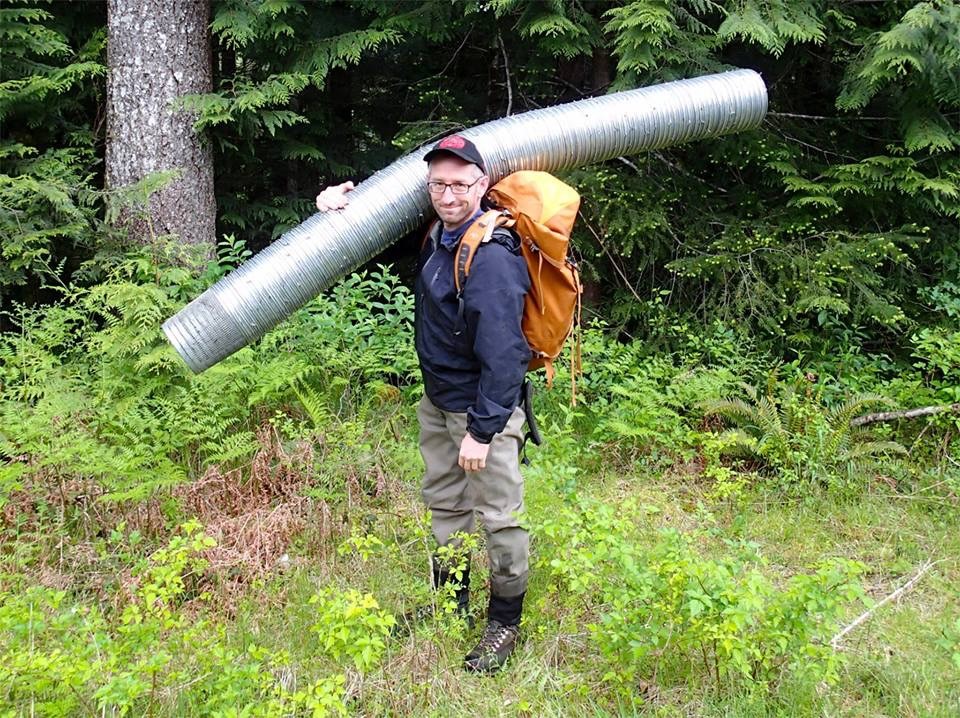
Mike - camping on a camera trap/fishing trip.

The first cameras that Mike deployed did not really impress me. The quality of the images was just so poor that, while I could see a bear was there (or not), I couldn’t really get excited about it from a nature photography perspective. But, as the years passed, Mike got better and better cameras and the potential became more apparent – especially for videos, where low image quality is smoothed over by the excitement of action. So I decided to get into the act, buying a high-quality (for the time) Browning camera that I placed on a salmon spawning stream. Sometimes it worked and sometimes it didn’t but, in the former cases, the videos were sometimes transcendent. I needed to do more with this.

The second beginning to this story was on my family’s vineyard in Napa, California. I have told this part of the story in a previous post HERE but, in essence, I conducted a research project with my kids – Aspen and Cedar – where we studied the stickleback found in the creek running alongside the vineyard and in the reservoirs on the vineyard. I hadn’t planned to do this study but the kids spotted the stickleback on our walks around the vineyard and it was just too much – I studied stickleback in lakes (here reservoirs) versus creeks and I also studied rapid evolution (the stickleback populations couldn’t be more than 35 years old).

Aspen and Cedar doing stickleback research.

So, with Aspen (then six) and Cedar (then three), we collected stickleback and then – back in Montreal after sabbatical – used my Mom’s microscope to manually measure the traits I knew were important for adaptation to lakes versus streams. Finally, with input from everyone, I wrote up a paper and published it in the journal Evolutionary Ecology Research. Cedar and Aspen were full partners in the work and so were co-authors on the paper. The experience left us hoping for another family research project.


Walk This Way

These two beginnings coalesced after I wrote a research grant to obtain high-quality cameras for remote observation in various locations. Most of the cameras were designed to take only images, which is the typical standard for research – yet a subset were designed to also take video. These were destined for deployment at our cabin and formed the basis for our next family research project.*

In recent years, nearly all of our camera traps have been deployed in a remote area near our cabin where animals use a 3.3 km ridge trail to navigate along a ridge. The trail is so defined that it looks like a hiking trail in some (modestly) popular area. Curiously, however, the trail occasionally splits and then comes back together again 10-100 m later. Walking this trail with my wife Heather, my brother Mike, and the kids, I would often speculate as to why these splits occurred. Were they because one type of animal (e.g., bears) preferred one path and another type of animal (e.g., moose) found it easier to navigate another? Or was it because moose with antlers had trouble navigating a route that was easier for moose without antlers? Or perhaps one branch looked easier (or more obvious) when travelling one direction (northwest) but the other branch looked easier when travelling the other direction. Or maybe some individuals were just right handed and others left handed, applying those biases to splits. Musing on these various options, we decided to pace our first set of the new camera traps on those splits. A year later, the entire trail had 10 camera traps deployed, six on various splits and four at various other locations.


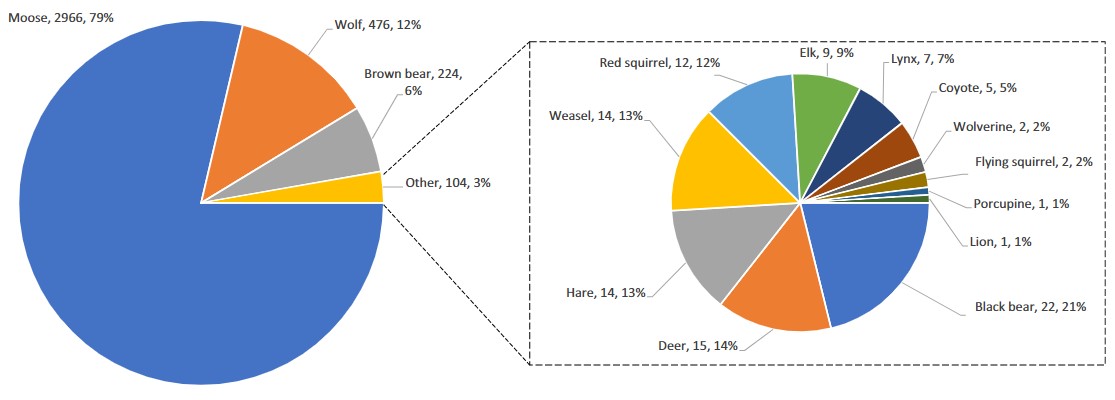
We left the camera traps out all year for three years – downloading data and replacing batteries as needed every year. Then COVID hit and we were spending way more time at home than before – providing an opportunity to finally analyze the data. Weekends – especially in winter - became a ritual. We would sit in front of my computer for a few hours each day, watching each video and recording the species of animal and various other attributes. For the three years of camera trap deployment we ended up with 3770 observations, consisting mostly of moose (2966), wolves (476), and brown bears (224) – with additional observations of at least 12 other mammal species (lumping the various weasels – apart from wolverines – together).

But what should be the focus of our first paper based on these data? Although we might logically have decided to start with the above question about trail splits, something else jumped out right away – injured moose. In a number of the videos, moose could be seen limping through the field of view, with obvious angular displacements of their limbs – that is, a bending outward or inward at the carpus (equivalent to our ankle). These injuries would be so dramatic and obvious that they would seem incompatible with survival. Indeed, one of the images that will be forever burned into my retina is that of a moose trying to run along a gravel bar on three good legs, the other flopping around behind. The injuries on these camera traps, however, seemed to have at least partially healed – presumably because they never got as bad as the “floppy” stage.


Was it possible that the moose had simply healed enough to “deal” with these injuries – and now were not too severely compromised in their movement? Perhaps we could test that by comparing their movement patterns to those of uninjured moose. Indeed, even before this most recent camera trap deployment, we had seen moose with injuries on the older camera traps – and though perhaps that some of them (one anyway) was the same moose in multiple years. What would these new and better recordings reveal? We had 12 injured moose to work with – although (perhaps) some of those 12 were actually the same moose recorded in different years.


We first set out to ask if injured moose showed gross differences in their time of movement. We had previously noted – based on our older camera traps – that moose seemed to move upstream in the spring and downstream in the late fall and early winter. That pattern was confirmed with the three-year deployment of our new camera traps. The injured moose were no different in this respect.


We next examined more fine scale patterns of movement. For instance, moose tend to use the trail in a “contagious” or clustered fashion, with many moose passing the camera traps on one day, then several days with no moose passing, and then many moose passing again a few days later. Again, injured moose were no different. The typically moved along the trail on roughly the same days as most other moose were using the trail.


Finally, we examined the pace of movement – by measuring the time taken between the two most widely-separated traps on the trail on which a given injured moose was recorded. These estimates indicated that the speed of injured moose on the trail was 0.28 m/s to 1.33 m/s – with the first estimate (0.28 m/s) being an outlier. Were these speeds atypical? To answer this question, we needed to estimate the speed of uninjured moose across the trail – but uninjured moose were hard to identify. So we searched for individual uninjured moose that could be reliably identified across multiple camera traps in a paired design. That is, for each injured moose that transited the trail, we searched the surrounding days for an uninjured moose to which it could be compared – and we were successful for 11 of the 12 cases. Calculating speeds for these uninjured moose revealed no difference from the injured moose – they were all moving about the same speed.


In the rest of the paper, we speculate on the reasons for the apparent non-effect of obvious injuries on movement. In short, the key point is that probably only moose that could still get along well – even with the injury – would live long enough to be recorded on our camera traps. This is kind of like the old observation that bullet marks on war planes returning to base mysteriously seem to be absent from the engines and cockpits. Of course, we also discuss in the paper how these findings have broader implications – especially in relation to how natural selection works on organismal traits.

What’s next?


I am writing this on a rainy day at my cabin while on sabbatical. Tomorrow I will start to go out and pick up the camera traps that have been recording the past year. We will do the rest when the kids arrive in a few weeks. We now have two more years of data – beyond those already published – and we have a lot of observations I haven’t discussed here. What will be the next family paper? Maybe it will be about the splits. Or maybe about how various animals “use” the bear-marking trees. Or maybe the injured wolves, which in inordinately common. Whatever it is, the rewards of family research will continue to accrue.

Or I could just focus on posting TikTok videos on @cameratrapclassics.


* I suppose it is worth noting that – beyond purchase of the cameras – no research funds were used for any travel or remuneration of myself or my family. In short, neither I nor my family have received any monetary benefits from the work – quite the contrary, in fact, as we have invested a lot of our own personal funds in implementation of the project




Wednesday, July 20, 2022

The Inertia Fallacy - saved by stickleback?

In ecology and evolution, we often keep doing what we have always done – not the least because we really value long-term datasets and detailed understanding of a given system. As such, for the first 20 years of my career as a Professor, I carried out annual research on Darwin’s finches (and the plants they eat) in Galapagos, guppies (and their parasites) in Trinidad, and threespine stickleback along the west coast of North America. Nearly every year, we mounted a huge field expedition to each of those places – sometimes several trips in a given year – each with multiple students. And each of these systems has certainly yielded excellent papers and useful insights. Moreover, I have always valued the complementary insights that can be leverage by considering similarities and differences across the systems – a fact I always touted in my NSERC Discovery program grant applications. Here is an example from 2011.

My research seeks to advance our fundamental understanding of eco-evolutionary dynamics through research on three natural systems: Trinidadian guppies (Poecilia reticulata), threespine stickleback (Gasterosteus aculeatus), and Darwin’s finches (Geospiza spp.). Results from these systems are then to flesh out the [general framework] for interactions between ecology and evolution. The impact of this work will be an increased integration of evolutionary principles into ecology, conservation, and biodiversity science …

I can’t say the grant reviewers always liked this attempt to integrate work on three systems – perhaps because I couldn’t give enough detail about any one of them in the course of 5-page NSERC Discovery proposal.

Meanwhile, I have supported student-led intensive field research on snails and fishes and dolphins in Panama, fishes in Uganda, howler monkeys in Argentina, lemon sharks in Bahamas, native fishes in Chile, and more. For each of these extra systems (save one – sorry Joey), I made sure to take at least one personal field trip to help out – two trips in some cases. Although it all came off, it was a bit much at times – with each project suffering to some extent from limited money and time that I was able to invest. A bit “like butter scraped over too much bread,” as Bilbo might say.

And then COVID upended all of it – with McGill University taking the uber-conservative approach of forbidding all international research for two years. In the spring 2020, I had to prematurely uproot students doing field seasons in Trinidad and Galapagos – leaving them with insufficient data for the projects they had planned. And I had to completely cancel stickleback field work in Alaska, thankfully then carried forward to our AK-resident collaborators (thanks Kat and Jesse). Of course, the idea then was to pick up all of these long-term research projects immediately in 2021 so as to not really compromise their data sets. But then various COVID surges completely nixed all three field season in 2021. Now, with two years of zero data for all three long-term research projects, the introspection began. Should we bother to continue with finches, guppies, and stickleback? Or should we just stop with some of those systems, thereby redirecting optimal effort to the others – or should we start something new?


I reflected on this fork in the road for many months and eventually realized that, although everything was fine with how things had been going, I was perhaps caught in a fallacy that only the two-year COVID induced break would allow me to escape. Perhaps the best-known fallacy is The Concord Fallacy – named after the famous plane. The fallacy was that the Concord had always lost money, yet governments and companies kept investing in it simply because they had already invested so much already. As soon as they stopped investing money, the thought was that their existing investment would be forever lost and could never be recovered. So they just kept throwing good money after bad, or is it the other way around. After way too long, they eventually broke out of the fallacy and simply stopped the program.

The fallacy in which I was caught was a bit different. Specifically, I kept research projects going partly just because I had always kept them going. Every year, I would mounted field expeditions for finches, guppies, and stickleback – with huge investments, complicated logistics, and insane beaurocracy (VISAs, travel documents, animal care approvals, animal care training, collection permits, export permits, import permits, genetic resource permits, park use permits, ecological reserve permits, Species At Risk Act permits, fish transfer permits, Canadian Food Inspection Agency permits). Yes – no kidding – all of those things and much more, nearly every year.

Yes, we did good work in all three systems, and enjoyed it; but was that WHY we kept doing it? What were the prospects for BIG innovations in each system: conceptually and practically? Or were we just “filling in the corners” as Pippin might have put it? Maybe we could call it the Nikon Fallacy (I keep using Nikon simply because it is always what I have used and I have tons of Nikon equipment already) or the PC Fallacy (I keep using a PC simply because it is what I have always done); or, more generally, the Inertia Fallacy (I keep doing stuff mostly because I have always done it).

Once the two-year long COVID/McGill-imposed field work hiatus allowed me to see how my research program could be falling into the Inertia Fallacy, I decided to re-evaluate the situation and, in the end, drop intensive field research on finches in Galapagos and guppies in Trinidad – thus redirecting all efforts toward stickleback (and other emerging projects). Why?

1.                Research in Galapagos is extremely expensive (e.g., we have to take a cab [currently $50+ USD] every single day to the field site – often two cabs), limited (e.g., we have to work on an “open” population that is part of a larger island population – as opposed to the “closed” population of Daphne Major), and prone to insane beaurocratic hurdles (e.g., we often have to wait years to get our blood samples out – and sometimes the samples are lost by the authorities – yes, really!). The pay-off-per-dollar simply isn’t there for the marginal improvements that can be made over what we have already collected. Further, every student working on the systems is becomes frustrated when what they planned is wrecked through indifference from the authorities. Perhaps most importantly, it is completely impossible to do any sort of experimental manipulations with finches – and we can’t hold them in captivity either. (I am not saying that we should be allowed to do these things – only that it is impossible regardless.)


 2.                Research in Trinidad is very crowded. Many many research groups are using the same small set of research sites to answer similar questions – and those groups don’t always get along. It is stressful for the students – and even for the PIs. Also, for 5 years, the Canadian Food Inspection Agency (CFIA) inexplicably prevented us from bringing guppies back from Trinidad to Canada. (OK, they kind of allowed it at some level but the hurdles were beyond the pale – including large cash outlays and the killing of a huge fraction of the fish we brought back.) It seems they have recently removed guppies from their “list” but whose to say they won’t put it back. Perhaps most critical, however, Trinidad is the least safe of the places we work, with students sometimes having very negative interactions with local people. (One year, a person was shot and their body dumped in our driveway – this had nothing to do with us – it just happened where we were.) I should note though that we also have had truly outstanding interactions with many local people who have helped us out. But that doesn’t change the fact that it is definitely the most dangerous of our field sites – especially if we also throw in snakes (we see many Fer-de-Lance, although no one has yet been bitten) and diseases (many guppy researchers have had Dengue Fever – including myself). I love Trinidad – I really do. There is nothing quite so pleasant as walking along a pristine stream in perfect temperatures, and camping under a high canopy while Bellbirds, Oropendulas, Oil Birds, and Manakins make the forest around you come alive. But does this enjoyment off-set the difficulties – some years floods (or droughts) completely scupper student plans.


This isn’t to say that my lab will stop working on these systems. Indeed, we have many papers on finches and guppies in the pipeline, and our long-term data and samples can be leveraged for years (probably my entire career and beyond). And some students will mount more focused and simple field expeditions to Trinidad and Galapagos – often in collaboration with local researchers.

Also, this post is not to discourage others from working on finches or guppies – they really are fantastic in many ways. Rather, I am just trying to explain the thought process that played out for me after we were completely unable to continue our research in Galapagos or Trinidad for two years, thus breaking the continuity of our long-term data sets.

So, why should I focus most future research toward stickleback – well, to a point, they are just the best:


0. Of the three systems, I  have longest history of working with guppies – starting in 1998. My finch and guppy work started in 2001.

1. Genomic resources for stickleback are vastly better than those for finches or guppies or, indeed, pretty much any other “natural” model out there. We don’t do the genomic work in my lab; but rather have a network of truly outstanding (the best, really) stickleback genomic collaborators (ping Rowan Barrett, Katie Peichel, Dan Bolnick, Daniel Berner).

2. Stickleback have a massive distribution; they occur naturally across the entire northern hemisphere, within a few hundred meters elevation of the ocean. We have already written papers combining samples from Vancouver Island (BC), Nova Scotia, Alaska, Iceland, Germany, Norway, and Switzerland. And we have additional stickleback research projects in California, Haida Gwaii, Quebec, and Russia – along with pending collaborations in Japan, Greenland, and beyond.


3. Stickleback have evolutionary replication nonpareil. Stickleback in different watersheds have independently evolved adaptations to their local environments following separate colonization by marine (anadromous) ancestors. This allows researchers to have virtually unlimited replication of whatever ecological contrast they care about: benthic versus limnetic (although the lakes with species pairs are few and very localized), lake versus stream, marine versus freshwater, different predator communities, different parasite communities, and so on.

4. Stickleback are also adapters nonpareil. They show incredibly dramatic divergence in numerous traits (plates, spines, gill rakers, shape, etc.) among freshwater habitats – and many of those traits are readily visible to the eye and have a known genetic basis. Further, the develop massive genome differences on very small spatial scales – for example, numerous (nearly) fixed allele frequency differences over a 100 m habitat transition in Misty Lake versus Inlet Stream fish.


5. Many instances are known where stickleback populations have recently (last 50 years) undergone dramatic habitat shifts either naturally or artificially (human introduced) – allowing an unprecedent opportunity to study contemporary (rapid) evolution in natural settings.

6. Many opportunities are available for controlled replicated experimental introductions in nature. Indeed, we just introduced 10 new populations to help restore lakes that had been treated by managers with Rotenone to remove invasive species. The stickleback had to go back in – and the agencies were happy to let us do it. #WorldsGreatestEcoEvoExperiment


7. Stickleback are incredibly important mid-trophic level species in their ecosystems – not officially a “keystone species” (too abundant), an ecosystem engineer (too small), or a foundation species (too small again); but most definitely an “ecologically-important species.”

8. Stickleback have relatively short generation times (as short as one year) and are relatively easy to rear in the laboratory.

9. Stickleback researchers are – for the most part – super nice and collaborative.

I should note that I have a longer history with salmon, starting in 1991, and have continued to work with that group ever since. They also share some of the above qualities – along with the same habitats – and they have direct interactions with humans. Hence, I envision also continuing with – and expanding – my research projects on salmon.

I could go on but maybe that is enough. Now that I see my research program was subject to the Inertia Fallacy, I can break out of it and go all-in on stickleback (and salmon?) for the rest of my career. Wanna join? Just send me a message – we have many cool new projects clamoring for new students.


Friday, May 20, 2022

Not by vaults and locks: To archive code, or not?

 The cases for and against archiving code

by, Bob Montgomerie (Queen’s University)

Data Editor—The American Naturalist


As of the beginning of this year, The American Naturalist required all authors of submitted manuscripts to upload to their data repository all of the code they used for analysis and modelling. About 80% of authors were already doing that by the time their paper was published, so it seemed like a general requirement for code at the reviewing stage would be useful for reviewers and editors, and especially end users once the paper was published.  Note that this requirement only applies if code was used; authors using drag-and-drop GUI software for analyses can generate code reports documenting their steps, but rarely do so. 


As data editor, I have now looked at about 100 scripts of R and Python code provided by authors. Based on that experience and my own coding practices for the past 55 years(!), I am not so sure that requiring code in data repositories is such a good idea. To that end, Dan Bolnick (current EIC), Volker Rudolf (incoming EIC), and I will hold a discussion session about this issue, and data repositories in general, at the Asilomar meeting of The American Society of Naturalists in January 2023 at Asilomar.


To provide a basis for that discussion, here are what I see as the cases for and against providing code, staring with the cons:


A1. Workload: For most of us, cleaning up the code that you used for analysis or modelling can be a ton of work—organizing, deleting extraneous material, annotating, checking that results match what is reported, providing workflow information.  It can also be a bit daunting to think that someone is going to look at your crappy coding practices—I know that it took me a month of work and deliberation before I posted my first code script in a public repository. Even now, having done this a couple of dozen times, I know that I am looking at a full day’s work to bring my code up to my rather minimal standards of usability and transparency.


Let me allay one fear right here—none of the 100+ code scripts I have looked at so far have been horrible. Everyone using R and Python seems to have adopted reasonable coding—though not necessarily reasonable statistical—practices. One person wrote code that was so compact and so elegant that it took me hours to figure out what the author had done. Normally I would not spend more than a few minute looking at code submitted with a manuscript, but I thought I might learn something useful, which I did. While I appreciated that author’s expertise, I would rather read and use code that is a little more friendly to the average user like me. My guess is that nobody cares how inelegant your code is as long as it’s well annotated and gets the job done.


On requiring code for papers submitted to The American Naturalist, Dan Bolnick (EIC at The American Naturalist) was a little worried that the extra work, and exposure to mediocre coding practices, would reduce submissions to The American Naturalist. At first there appeared to be a little downturn in submission rates t the start of 2022 but there are other potential causes for that (pandemic burnout, gearing up for a potential renewal of field work, etc). Even so, if this requirement discourages authors who are unwilling to be transparent about their analyses, then the journal and science benefit.


A2. Usefulness: One purpose, ostensibly, of published code is transparency, allowing reviewers, editors and readers to replicate what is reported in the manuscript and eventual publication. But my experience, so far is that hardly anybody does this. Reviewers and editors rarely seem to comment on the code that authors provide. Even the data editors do not check to see if the code produces the output that matches what is in the manuscript, nor even that all of the reported results are dealt with in the code. We do look at the code but only to address some formatting and accessibility issues (see A3 below).


As a user of published data, I much prefer to write my own code to see if the results that I get match those reported by the authors. If there is a mismatch it might be interesting—but rather tedious—to figure out where the authors went wrong, but I am not sure that their advantages of such forensic work unless scientific misconduct is suspected. A disturbing proportion of authors’ code that I have looked at so far contains what I would call statistical, rather than coding, errors, especially with respect to violating important assumptions or ignoring without comment any errors thrown up by the code. Checking for those errors should really be the job of reviewers and editors but is probably considered to be far too time-consuming.


A3. Accessibility: The vast majority of R and Python scripts that I have looked at so far will not run ‘as is’ on my computer. The most common reasons for this are that authors write scripts that (i) try to load files on the author’s hard drive, or even to files that do not exist in their data repository, (ii) are so poorly annotated that the purpose is far from clear, (iii) use packages that are not on CRAN etc with no information as to where to get them, (iv) throw up error messages with no comments as to why those errors were ignored, (v) use deprecated functions and packages from versions much earlier than the current version (often with no package version info provided), or (vi) require a specific, and unspecified, work flow. I have enough experience that I can usually deal with those deficiencies in minutes but I worry about other users just throwing up their hands when code does not work, or not willing to  put in the time and effort to fix the code. Moreover, code written today will not necessarily run ‘as is’ in a few months or years, as the coding environments, packages, and functions evolve and often become deprecated. Unlike well documented datasets, saved in a universal simple format like csv, code has the potential to become obsolete and almost unusable in the future. Can anyone open my  VisiCalc files—my go-to spreadsheet app in the late 1970s?  


The data editors at The American Naturalist ask authors to fix their code when they identify those deficiencies, but we simply do not have the time or inclination to work with authors to make their code completely transparent and usable. We take a fairly light touch on this to help, rather than discourage authors, and presumably practices will improve as everyone gets used to submitting code to journals. Most journal editors and reviewers probably do not have the time or expertise to deal with code in addition to handling manuscripts.


And the advantages, as a counterpoint to the disadvantages listed above:


F1. Workload: This is work you should really be doing whether or not you make your code publicly available in a data repository. Your future self will thank you when it comes to revising your manuscript, or at some later date needing to reanalyze those data. Reusing well-annotated code is also just standard practice among coders, rather than re-inventing the wheel every time you repeat an analysis or a modelling exercise. When developing analyses in R or Python, for example, it can be tremendously time-saving to (i) use versioning, (ii) comment extensively to explain what you are doing and why, (iii) use R or jupyter (or other) notebooks to keep a running commentary of the purpose of chunks of code and the conclusions that you draw from analyses


F2. Usefulness: Code is undoubtedly extremely useful for modelling exercises, where little or no empirical data are used, and the research depends entirely on the code. Presumably reviewers and editors handling such manuscripts take a close look at the code to make sure that the authors have not made any obvious mistakes that would lead to incorrect conclusions.


For research based on data analyses, published code can be very useful for training students, as well as researchers beginning to do some coding. I often use published code in my own work especially when learning new analytical procedures. Especially in my graduate and undergraduate statistics courses, students seem to appreciate those real-world examples. As I mentioned above, re-using code is standard practice although most of us probably get the most useful code from blog posts, online manuals, and stack overflow. Despite that usable code associated with a publication can help you to replicate the authors’ methods in your own work.


F3. Accessibility: With R and Python, at least, previous language and package versions are available on the internet so that users can recreate the environment used by the original coder. There are also sites online that can facilitate this. As authors get into the practice of providing version information, and adequately commenting their code, the problems of accessibility should largely be alleviated as the analysis software evolves.


Food for Thought

As the scientific publishing environment evolved over the past 250 years, and especially in the last two decades, we have all more-or-less seamlessly adapted to the new environments. The requirement to provide data and code in a public repository, however, has been a sea change that not everyone is comfortable with, yet. I am all-in for providing raw data but wonder whether the requirement for providing code has enough benefits that it is worth pursuing at least in the short term. We have identified errors and deficiencies in more than 75% of the datasets archived with manuscripts from The American Naturalist in the past year, and I would like to see that problem solved first. To that end, I feel that undergraduate and graduate student education needs to focus as much on data management as on any other aspect of doing good science. 


“Since the first satellites had been orbited, almost fifty years earlier, trillions and quadrillions of pulses of information had been pouring down from space, to be stored against the day when they might contribute to the advance of knowledge. Only a minute fraction of all this raw material would ever be processed; but there was no way of telling what observation some scientist might wish to consult, ten, or fifty, or a hundred years from now. So everything had to be kept on file, stacked in endless airconditioned galleries, triplicated at the [data] centers against the possibility of accidental loss. It was part of the real treasure of mankind, more valuable than all the gold locked uselessly away in bank vaults.” 
― Arthur C. Clarke


“Let us save what remains: not by vaults and locks which fence them from the public eye and use in consigning them to the waste of time, but by such a multiplication of copies, as shall place them beyond the reach of accident.” 
― Thomas Jefferson*

*Jefferson is a divisive figure because of his defense of, and involvement in, slavery. 

Monday, May 9, 2022

The Spine of the Stickleback

How an first-year undergrad drove more than 15,000 km to brave mosquitoes and forest fires en route to photographing, fin clipping, and releasing more than 10,000 stickleback in the #WorldsGreatestEcoEvoExperiment. By Ismail Ameen

Left to Right: Ismail Ameen, Hillary Poore, and Victor Frankel somewhere in the Kenai Peninsula

With the bustle of Calgary fading behind me, and the rolling green hills of Alberta’s countryside flanking me from either side, the golden sun mid July exposed the enormity of the country I was passing through. I had just completed a month of ecological field work in Kenai Alaska, and was trekking back to Montreal with 3 fellow researchers. We were carrying a valuable cargo. Countless samples detailing key features of lake ecosystems primed for an evolutionary journey.

I first became exposed to the field of Eco-Evolutionary Dynamics (eco-evo) after reading Jonathan Weiner’s book “The Beak of the Finch” which covers the groundbreaking research of Peter and Rosemary Grant. The Grant’s research concerned the finches of Daphne Major in the Galapagos, where they found that natural selection was not just limited to being a slow process as Darwin described, but could also act at rapid timescales. In the span of a few generations, selection could impose significant changes on a population. Instilled with a newfound curiosity, I reached out to Professor Andrew Hendry who was teaching my introductory biology course. Following his recommendation, I read his book on Eco-Evolutionary Dynamics (2017 – Princeton University Press) to gain a somewhat better idea of the field and its goals. Essentially, eco-evo studies the following feedback loop:

Ecological dynamics shaping evolution

Merging the fields of evolution and ecology in this way is particularly useful since the two are intrinsically linked. Thus, understanding how the two interact has numerous downstream benefits that extend to applied sciences like conservation and agriculture.

Upon completing the book, I was inspired by the sense of power this field of research bestows. Understanding eco-evo is akin to grasping a fundamental law of life on this planet. Filled with a sense of purpose, I immediately sought to participate in research. My efforts paid off, as Professor Hendry offered me a spot on a field research team whose goal was to set up a large eco-evo study in Alaska.

The team, comprising PI’s, grad students, and undergrads from multiple universities, had several objectives, but all of them revolved around one species: the threespine stickleback. This bony little fish provides an extremely powerful tool to evolutionary biologists, acting as a “supermodel” species that can be studied from multiple angles (molecular, genetic, ecological, etc.). Freshwater stickleback also happen to be a keystone species in lake ecosystems, meaning that they are essential to local food web stability. The essential niche they occupy isn’t set in stone, however,  as two stickleback “ecotypes” arise depending on the circumstances. The first ecotype is the benthic form which are found at the bottom of the water column, while the second ecotype is the limnetic form which are found towards the surface of the lake. Benthic stickleback mostly feed on larval insects on the lake bottom whereas limnetic stickleback mostly feed on zooplankton in the water column. Leveraging the importance of stickleback to food web stability, and the clear difference in ecotypes, Professor Hendry and the other PI’s developed a unique experimental design.

The Experimental Design:

An ideal experiment to test the importance of stickleback ecotype to lake ecosystems might look like this: start with lakes devoid of any stickleback and introduce benthic stickleback into some of them and limnetic stickleback into others. Then track the resulting changes in various ecosystem parameters through time. Additionally, population characteristics of the stickleback could be tracked to elucidate the interactions between stickleback and their ecosystem.

Designing an experiment like this is one thing, but actually implementing it is another. Luckily, one of the PI’s (Mike Bell) was working with Alaska Fish and Game, who were using Rotenone to completely clear 10 lakes of their fish populations to combat invasive pike. This provided the opportunity to run the experiment in a natural setting.

Before I got to Alaska, several years of preparation had occurred which culminated in a plan to source and transplant stickleback. One of the most important aspects of this plan was the generation of pools of benthic or limnetic stickleback formed from multiple source lakes. These pools could then be transplanted into recipient lakes. Pooling improved the chances of recipient lake recovery as the mixed populations would be more resilient to hazards that could destroy a single source lake population. Pooling would also allow for generalizations to be made about benthic and limnetic stickleback due to the replication embedded in the pools’ construction (multiple sources reduces the bias of one source). Ultimately, 8 source lakes were decided upon with an even division in geographic region, and stickleback ecotype (Table 1). 4 source lakes of the same ecotype contributed equally to a pool to mitigate the potential of one source lake dominating the others.

Table 1: Source lake pools

Source Lake:

Stickleback Ecotype:

Location:

Tern

Benthic

Kenai

Watson

Benthic

Kenai

Walby

Benthic

Mat Su

Finger

Benthic

Mat Su

Spirit

Limnetic

Kenai

Wik

Limnetic

Kenai

South Rolly

Limnetic

Mat Su

Long

Limnetic

Mat Su

Table 1: Here I present the 8 source lakes used for transplant. Source lakes were classified as either benthic or limnetic. The 4 benthic and 4 limnetic lakes were combined, respectively, into pools which were then transplanted into recipient lakes.

Overall, there were 9 recipient lakes. 4 of the recipient lakes received benthic stickleback, while another 4 received limnetic. Since one of the primary goals of the study was to observe the interactions between a particular ecotype and its environment, recipient lakes were paired based on ecological similarity and size. This would allow us to transplant the benthic or limnetic pool in two lakes of similar ecology, increasing inferential power on the effects each ecotype has. It was especially important to keep lake pairs geographically isolated from each other to prevent ecotypes from mixing due to watershed connections. Additionally, to account for the size differences in lakes, non-linear scaling of stickleback transplant numbers was applied (Table 2). Finally, Loon lake received an equal proportion of the transplant lakes in order to monitor how the two ecotypes interact in the same environment.

Table 2: Recipient Lake Transplant Numbers

Recipient Lake:

Ecotype Pool:

Number of Stickleback

Leisure Pond

Benthic

400

Fred Lake

Limnetic

400

CC Lake

Benthic

800

Ranchero Lake

Limnetic

800

Leisure Lake

Benthic

1600

Crystal Lake

Limnetic

1600

G Lake

Benthic

2400

Hope Lake

Limnetic

2400

Loon Lake

Benthic + Limnetic

Dependent on sampling logistics

Table 2: Here I present the recipient lakes along with the number of stickleback they received, and the pools those stickleback came from. As seen in the “Number of Stickleback” column, scaling was non-linear in order to balance transplant logistics, Alaska Fish & Game advice, and experimental utility.

Onsite: The Challenges of Field Work

Once I arrived at the field site, I realized just how rigorous the field work was going to be. Thousands of stickleback were going to have to be captured, processed, and transplanted to set up the experiment. Even the processing required a tremendous amount of detail be applied to each stickleback since every fish received an ID number, photograph, and a fin clipping for gene sequencing. The extra effort would be worth it, as the data that would be collected in that one month created a high resolution snapshot of the initial conditions in each lake. In essence, we were building a baseline that could support future research endeavors for decades to come.

Anesthetized stickleback after being ID'd and clipped.
It would only be a short time before he started a new life in a fresh lake.
Needless to say, our task was not without complications. Three major obstacles needed to be overcome during the course of the field work. The first was the issue of optimizing stickleback processing. Thousands of fish needing to be processed meant that at any given moment of the day, at least 3 of us field assistants would be processing stickleback. As time went on, we each became better at our individual roles in the processing pipeline, forming a well oiled machine that could handle up to 1,000 stickleback in a day. Another problem posed by the number of stickleback we needed to transplant was making sure they survived from capture to release. Some of the source lakes were several hours from the processing station, and stickleback could be held for several days before being released. In order to keep survival high, we constructed an elaborate “aquarium” outside the cabin with shade and air bubblers. Furthermore, clear communication between the processing team and the transplant/capture team allowed for the fastest possible transition between capturing, processing, and releasing a stickleback.

Stickleback capture! Here I'm showing off some of the minnow traps we used to catch stickleback

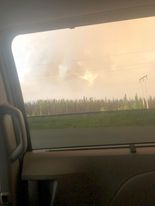
The second issue was that Alaska was in the height of forest fire season. High temperatures and summer storms brought about fires which could last weeks. In several instances these fires came right up to the lakes we were working with. Towards the end of the field work, a final collection from a source lake needed to happen to meet our quota. As I drove out to the lake with another researcher we were forced to take a back road to get past traffic. With smoke limiting our visibility, and a few close calls with local wildlife, we finally made it to the lake only to see swarms of firefighters preparing to control the incoming blaze. What followed was a manic sprint through the swampy shore to collect the stickleback before hightailing it back to the cabin, feeling, perhaps a bit dramatically, like we’d just escaped with our lives.
Driving beside a forest
fire on the way to a transplant site
While this was definitely the closest call during the course of field work, forest fires constantly kept us on our toes logistically to make sure lakes received the right amount of stickleback. Once again, clear communication, and overnight trips helped us overcome this obstacle.

In a state like Alaska which has a history of homesteading and self sufficiency, residents were primed to be suspicious of government efforts. Gaining these people’s trust required direct communication and transparency. This was accomplished in two main ways. The first was through our main contact at the Alaska Fish and Game Rob Massengill. Rob was extremely excited by our work, and had a good relationship with all the residents we’d be interacting with. As a result, he became an invaluable bridge to communicate with the locals. With Rob’s endorsement, residents were more open to giving us a chance to work on their property.

The second step we took to build a relationship with residents was to host a barbecue. It turns out that when ~20 ecologists put their heads together, they come up with a pretty awesome barbecue. We saw a huge turnout in residents coming by our cabin for food, drink, and to learn what we were doing. The result was overwhelmingly positive. Once residents understood that our work would (A) benefit the lakes they lived near, and (B) give them better fishing opportunities, they tended to support us. It was at this barbecue that I realized that science requires communication. That if it is never explained to the general public, it won’t do the maximum amount of good it can accomplish. Personally, I came to realize that my excitement towards the field isn’t universally shared, but by face to face communication I could frame that excitement in a way that appealed to someone who may have had reservations.

One of the final transplants.
While it may not look momentous, this
was one of the most profound moments of field work
At the end of June our numbers had whittled down to just 5 remaining researchers. Our last release was down a muddy road and through a swarm of mosquitos. Once we reached the dock, and watched the last of the stickleback swim away, I was hit with the profundity of our work. It is rare in eco-evo to be able to set up such a large experiment in freshwater ecosystems. Smaller systems are often required since expanding the system introduces more and more noise. In this special scenario we were able to access a large system with reduced noise. And with that we could collect data on the key markers for evolution and ecology (defensive traits, invertebrate populations, limnology, etc.). All of these features were captured in incredible detail due to our efforts. From these data, and future work, deep understandings of how stickleback trait space is evolving, and how that evolution is influencing the environment, can be gained. As our understanding of how these lakes develop, and what forces are at play grows, then our policy towards the conservation of these and other lakes can be more impactful. Furthermore, not only had our work yielded quality data, but also quality methods. We had optimized processing, worked out a logistics plan, and most importantly, built a relationship with local residents. Our work ensured that future sampling could be conducted much more easily.

Upon completing the journey back to McGill, I had to take a victory photo with some souvenirs we brought for the museum.

Ultimately, my field season was an episode of great personal growth, and quite a bit of learning. I was able to harness my passion of the field, and direct it towards something that furthered the field. I was able to see all the behind the scenes work that goes into doing good science. Science that doesn’t just, hopefully, lead to important discoveries, but science that benefits people in the process of being conducted. If I were to generalize, I would argue that is one of the main reasons eco-evo is so important. Its utilitarian nature does good for science, for the environment, and for the community. 


The Null Hypothesis is Always Wrong

 No two populations are identical for any trait. No two communities have the same species composition. No detectable phenotype is ever compl...